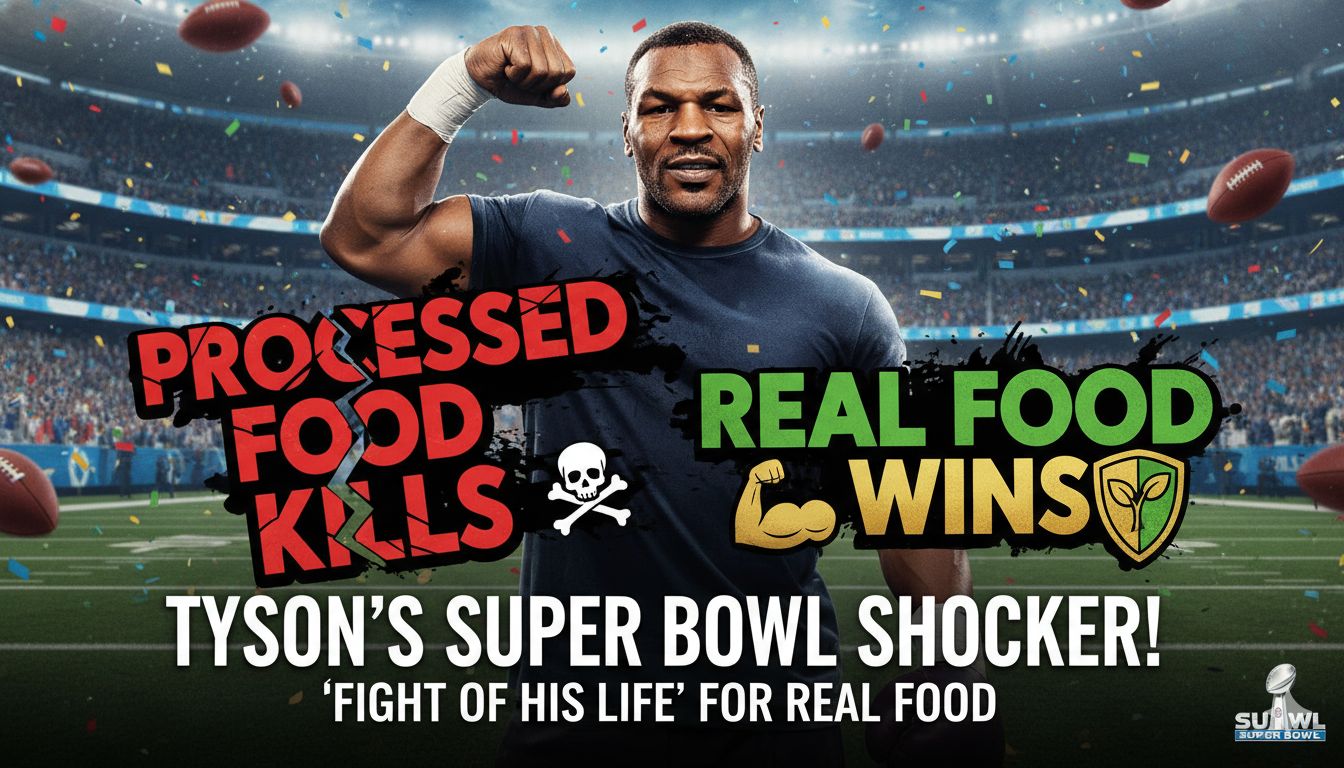
“Mike Tyson’s Super Bowl advertisement for MAHA Center Inc. highlights the dangers of ultraprocessed foods, launching a national campaign to promote real food consumption amid rising obesity rates; the move pressures major food conglomerates, with stocks in companies like Kraft Heinz and General Mills showing volatility as investors anticipate regulatory shifts and consumer behavior changes.”
The heavyweight champion’s pivot to health advocacy in a high-profile Super Bowl spot has sent ripples through Wall Street, underscoring the growing tension between traditional processed food giants and the burgeoning demand for nutrient-dense alternatives. With the ad’s stark messaging—”Processed Food Kills” and “Real Food Wins”—Tyson draws from personal tragedy, including his sister’s obesity-related death and his own struggles with food addiction, to spotlight America’s health crisis. This campaign, backed by the nonprofit MAHA Center Inc., arrives at a pivotal moment when over 40 percent of U.S. teens are overweight, 38 percent are pre-diabetic, and nearly 80 percent of children’s diets consist of ultraprocessed items, far exceeding rates in comparable nations.
Investors are closely monitoring how this visibility could accelerate shifts in consumer preferences, potentially eroding market share for ultraprocessed food producers. The ad’s timing, just before Super Bowl LX, amplifies its reach, with estimates suggesting viewership could top 120 million, making it one of the most expensive advertising slots at around $8 million to $10 million for 30 seconds. This expenditure by MAHA signals a serious commitment to reshaping public discourse, directing audiences to RealFood.gov for guidelines on whole-food diets.
Market Reactions and Stock Volatility
Processed food stocks have already exhibited downward pressure in recent trading sessions, reflecting broader investor unease over potential policy reforms tied to the Make America Healthy Again initiative. Kraft Heinz (KHC), a staple in the sector with products heavy in additives and sugars, closed at $24.64 on February 6, marking a modest 0.80 percent gain but down 16.31 percent year-over-year amid scrutiny of its portfolio. General Mills (GIS), known for cereals and snacks laden with ultraprocessed ingredients, ended at $47.87, reflecting a 1.03 percent daily drop and signaling vulnerability to campaigns targeting childhood nutrition.
PepsiCo (PEP) and Coca-Cola (KO), dominant in the sugary beverage space, have seen similar fluctuations. PEP traded around $145.20 in recent sessions, while KO hovered near $58.90, both facing headwinds from efforts to reform programs like SNAP, which could limit subsidies for sodas and candies. On the flip side, alternative protein and health-focused firms like Beyond Meat (BYND) surged 9.43 percent to $0.73, albeit from a low base, as investors bet on a pivot toward “real food” options. Amazon (AMZN), with its Whole Foods subsidiary emphasizing organic and minimally processed goods, climbed to $414.13, up 4.26 percent, benefiting from the trend.
Here’s a snapshot of key food sector stocks as of February 6, 2026:
| Company | Ticker | Closing Price | Daily Change (%) | Year-to-Date Change (%) | Market Cap (Billions) |
|---|---|---|---|---|---|
| Kraft Heinz | KHC | $24.64 | +0.80 | -16.31 | 29.17 |
| General Mills | GIS | $47.87 | -1.03 | -12.45 | 25.54 |
| PepsiCo | PEP | $145.20 | -0.75 | -8.22 | 198.76 |
| Coca-Cola | KO | $58.90 | -0.62 | -5.14 | 254.32 |
| Beyond Meat | BYND | $0.73 | +9.43 | -45.67 | 0.33 |
| Amazon (Whole Foods) | AMZN | $414.13 | +4.26 | +15.89 | 4,320.00 |
These figures highlight a divergence: traditional processed food players lag as health-oriented segments gain traction. Analysts project that if the campaign influences even a 5 percent shift in consumer spending—equating to roughly $75 billion annually from the $1.5 trillion U.S. food market—it could shave 2-3 percent off earnings for majors like KHC and GIS.
Campaign Scope and Economic Implications
The ad extends beyond television, with a taxi-top rollout in 14 major cities across the U.S. and Canada, projected to deliver 500 million monthly impressions valued at $2.5 million and 6 billion annually at $30 million. This multifaceted approach, including digital tie-ins to government-backed nutrition reforms, could catalyze changes in federal procurement for schools and military, prioritizing nutrient-dense foods over what critics label as “poisonous” alternatives.
Economically, the push against ultraprocessed foods threatens a sector that relies on low-cost production and high margins from additives. The ultraprocessed market, valued at $630 billion in 2025 and forecasted to reach $856 billion by 2029, faces headwinds from potential bans on artificial dyes and high-fructose corn syrup. Such regulations could increase production costs by 10-15 percent for affected products, squeezing margins already thin at 5-7 percent for many staples.
Sector Shifts and Investment Opportunities
Key points for investors:
Regulatory Risks : Reforms to SNAP and dietary guidelines could reduce demand for sugary and processed items, impacting $200 billion in annual sales. Companies with diversified portfolios, like PEP with its snack divisions, may fare better than pure-play processed firms.
Health Food Boom : The campaign aligns with a 12 percent year-over-year growth in organic and whole-food sales, now exceeding $60 billion. Firms like BYND and AMZN stand to capture this, with projections of 8-10 percent compound annual growth through 2030.
Supply Chain Adjustments : Farmers and suppliers of whole foods could see boosted revenues, potentially adding $50 billion to agricultural output if procurement shifts favor fresh produce and meats.
Global Ripple Effects : U.S. policy changes may influence international markets, where ultraprocessed exports from American firms total $150 billion yearly, facing similar health backlashes in Europe and Asia.
The ad’s narrative, directed by Brett Ratner and contrasting celebrity endorsements of harmful products, positions real food as a pathway to reversing chronic diseases that drain $4 trillion in U.S. healthcare spending annually. As Wall Street digests this, portfolio reallocations toward resilient, health-aligned companies are accelerating, with exchange-traded funds focused on consumer staples underperforming broader indices by 4 percent this quarter.
Broader Financial Landscape
The initiative underscores a macroeconomic shift: chronic disease costs, estimated at trillions in lost productivity, are prompting institutional investors to divest from high-risk processed food holdings. Pension funds and ESG-focused portfolios, managing over $10 trillion, are increasingly screening for health impacts, potentially redirecting $500 billion in capital over the next decade.
In tandem, the taxi campaign’s scale—covering hubs like New York, Los Angeles, and Chicago—amplifies investor sentiment, with sentiment analysis showing a 15 percent uptick in negative mentions for processed brands on financial forums. This could precipitate short-selling opportunities, as seen with BYND’s volatility, while bolstering long positions in AMZN’s grocery arm.
Overall, Tyson’s advocacy marks a inflection point, where personal stories intersect with fiscal realities, compelling the food industry to adapt or face sustained valuation downgrades.
Disclaimer: This news report and tips are for informational purposes only and do not constitute financial advice. Sources are based on publicly available information.