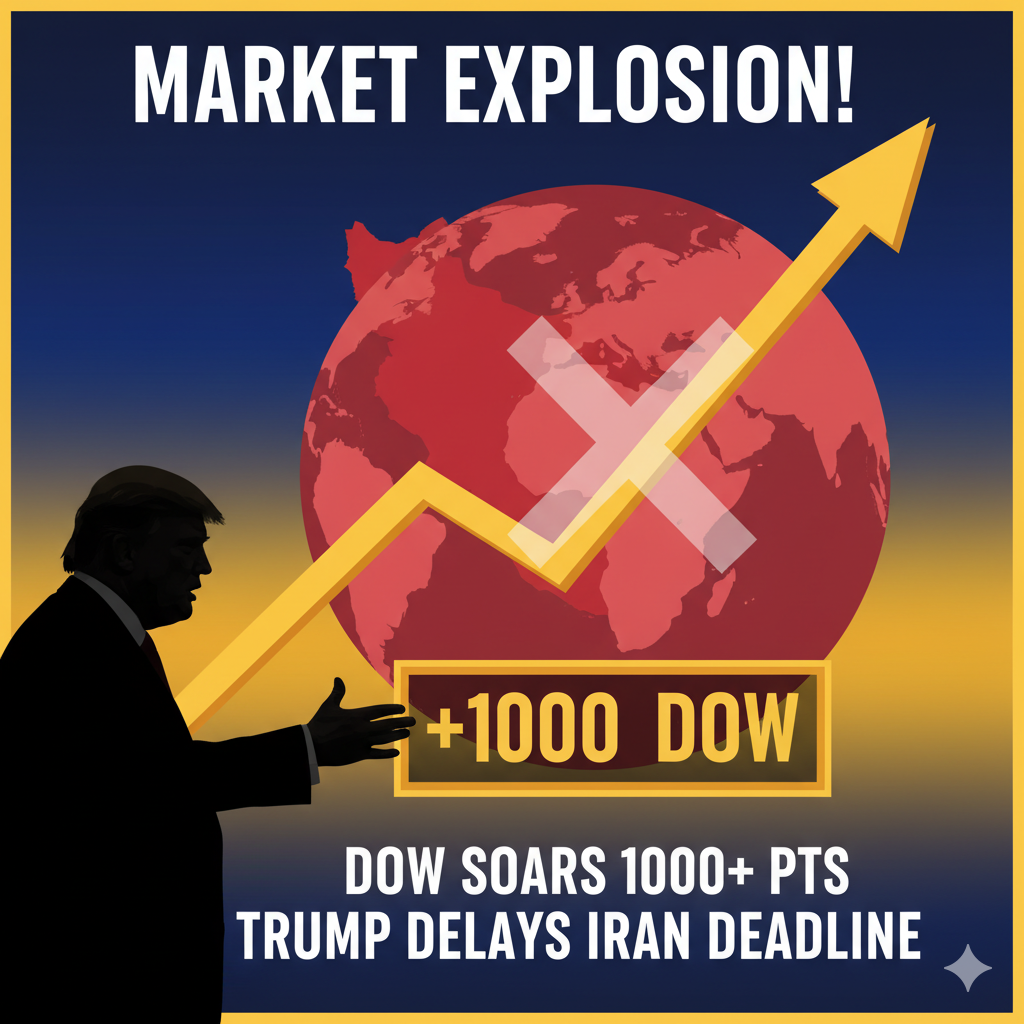
**” In a dramatic market reversal, the Dow soared over 1,000 points intraday after President Trump delayed an ultimatum to Iran, easing fears of escalated disruptions to global oil supplies through the Strait of Hormuz. Oil prices plunged sharply while equities rallied on hopes for de-escalation in the U.S.-Iran war. “**
Dow Jumps Over 1,000 Points on Trump’s Iran Delay
Wall Street opened with intense volatility but quickly shifted to strong gains following the president’s announcement. Prior to the update, futures had indicated potential declines amid lingering concerns over the four-week-old conflict and threats to energy flows. The reversal came swiftly after Trump posted on social media that “very good and productive” talks had taken place, prompting him to instruct the military to hold off on targeting Iranian power plants and other energy assets for five days to allow discussions to continue.
The Dow Jones Industrial Average climbed as much as 1,135 points during morning trading, representing a peak gain of around 2.5% from Friday’s close near 45,577. By midday, it held gains around 700 points or 1.5%, with broader participation across sectors. Energy stocks, which had faced pressure from earlier oil volatility, stabilized, while consumer discretionary, technology, and financial names led the advance as risk appetite returned.
The S&P 500 and Nasdaq Composite also posted solid gains, with the tech-heavy Nasdaq up over 1.3% in midday action after futures had signaled sharper moves higher. Over 90% of S&P 500 components traded in positive territory at points during the session, reflecting broad-based relief rather than isolated sector strength.
Oil markets reacted even more dramatically to the news. Benchmark U.S. crude, which had approached or exceeded $100 per barrel in recent sessions amid blockade fears, fell sharply—dropping as much as $8 to trade around $90. Brent crude, the global standard, tumbled more than $9 to hover near $103 before further easing. The pullback in energy prices provided immediate tailwinds to equities, as lower input costs benefit transportation, manufacturing, and consumer sectors.
The backdrop to Monday’s rally stems from heightened tensions over the Strait of Hormuz, a critical chokepoint for roughly one-fifth of global oil and natural gas shipments. Iran had effectively restricted passage in response to ongoing hostilities, driving oil higher and stoking inflation worries. Trump’s weekend ultimatum had demanded full reopening or face destruction of energy infrastructure, leading to retaliatory warnings from Tehran targeting regional assets. Asian markets had absorbed the brunt earlier, with sharp declines in Japan, South Korea, and elsewhere as investors priced in supply risks.
Trump’s deferral shifted the narrative toward diplomacy. He described the conversations as detailed and constructive, with potential for a “complete and total resolution” if progress continues. Markets interpreted the move as buying time to avoid a severe energy shock that could tip the global economy toward recessionary pressures already amplified by the conflict.
Key Market Moves
Dow Jones Industrial Average : Intraday high surge exceeding 1,000 points (peak 1,135), midday +1.5% ( 700 points)
S&P 500 : Up ~1.2-2% in sessions, futures had flipped from -1% to +2.6%
Nasdaq Composite : Gains around 1.3-2.5%, benefiting from growth stock rebound
Crude Oil (WTI) : Down sharply to ~$90/barrel after earlier highs
Brent Crude : Fell to ~$103/barrel, erasing much of prior spike
Investors remain attuned to the fluid situation. While the five-day window offers breathing room, any breakdown in talks could reignite volatility. The conflict’s duration—now entering its fifth week—continues to influence sentiment, with elevated energy costs still a risk factor for corporate margins and consumer spending.
Broader indices reflected the relief trade. Small-cap Russell 2000, which had entered correction territory recently, participated in the upside. Bond yields retreated modestly as safe-haven demand eased, and the U.S. dollar softened against major currencies.
The session underscores how geopolitical headlines can dominate price action. Energy security remains front and center, with the Strait’s status directly tied to inflation trajectories and Federal Reserve policy considerations. For now, the market has embraced the pause as a step back from the brink.
Disclaimer: This is a news report based on market observations and public statements. It is not investment advice, financial guidance, or a recommendation to buy or sell securities.