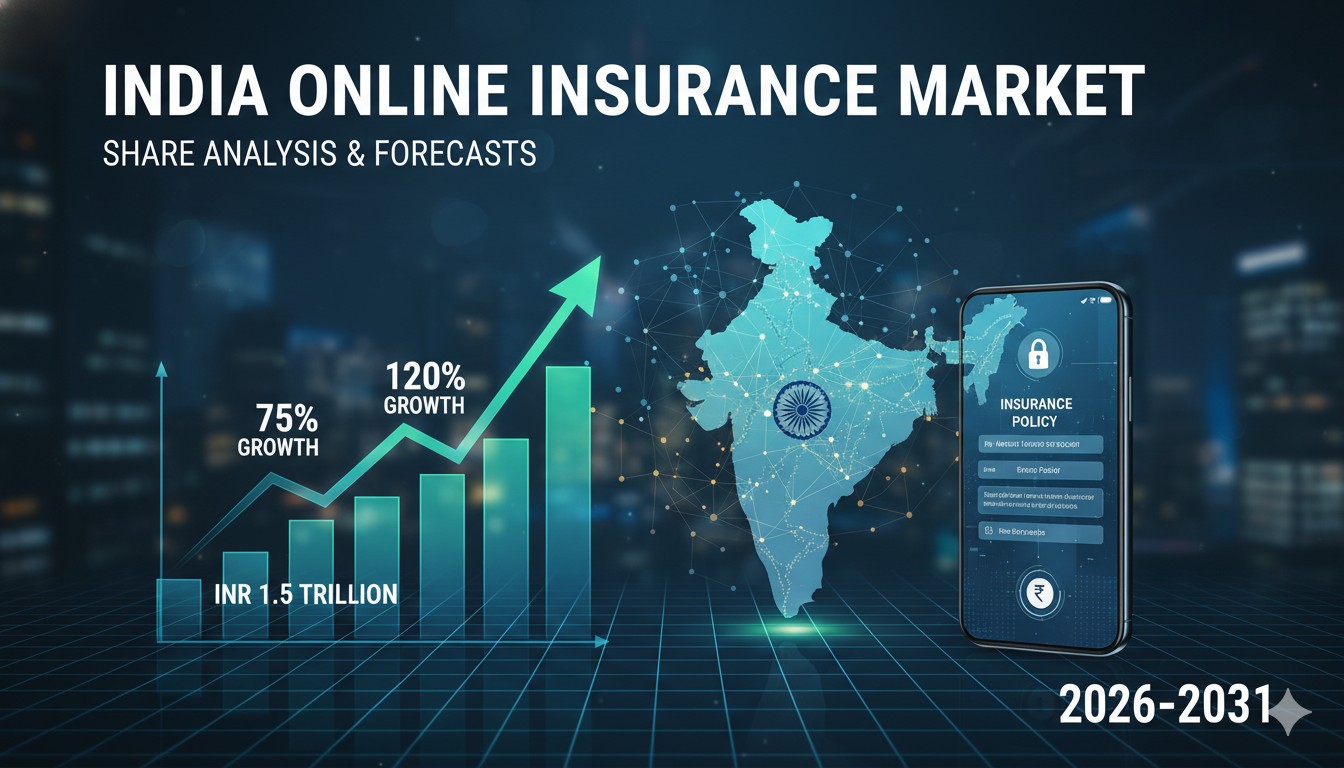
“The India online insurance market is set to expand from USD 283.26 million in 2026 to USD 549.89 million by 2031 at a 14.18% CAGR, driven by smartphone proliferation, regulatory innovations, and embedded insurance models. Property & casualty leads with over 40% share, while specialty lines grow fastest; retail individuals dominate customers at over 70%, with mobiles capturing more than half of transactions. Trends include AI personalization, UPI payments, and telematics, amid challenges like data privacy and low literacy.”
The online insurance sector in India stands at a pivotal juncture, with digital channels reshaping how policies are distributed, underwritten, and serviced. Rapid urbanization, coupled with a surge in internet penetration, has accelerated the shift from traditional agent-based models to seamless app-driven experiences. This evolution is particularly evident in metropolitan areas, where over 59% of premiums originate, though tier-2 cities are catching up through improved connectivity and localized offerings.
Market Share Analysis
Segmentation reveals distinct patterns across insurance types, customer groups, and platforms. In terms of insurance categories, property and casualty holds the largest slice, accounting for approximately 41.76% of the market as of recent estimates. This dominance stems from high demand for motor and home covers, often bundled with add-ons for natural disasters prevalent in regions like coastal states. Health insurance follows closely, buoyed by post-pandemic awareness, while life insurance gains traction through unit-linked plans that appeal to younger demographics seeking investment-linked protection.
Specialty lines, including cyber, pet, and travel insurance, are emerging as high-growth areas, projected to outpace others with a compound annual growth rate exceeding 15%. These niche products cater to evolving risks, such as data breaches in the booming e-commerce space or parametric covers for agriculture in rural pockets.
By customer segment, retail and individual buyers command the majority, representing about 71.35% of the market. This group benefits from simplified onboarding via Aadhaar-linked KYC and vernacular apps, making insurance accessible to first-time users in semi-urban areas. Small and medium enterprises (SMEs) and commercial clients, though smaller in share, are expanding rapidly, with tailored packages for liability and business interruption that integrate with digital banking tools.
Device-wise, mobile platforms lead with around 56.12% dominance, reflecting India’s smartphone boom that now exceeds 600 million users. Desktop and web access trail, but progressive web apps are bridging gaps for offline regions.
Geographically, major hubs like Mumbai, Delhi NCR, Bangalore, Chennai, and Hyderabad contribute the bulk, but tier-2 locales such as Pune and Ahmedabad are witnessing double-digit premium growth due to SME proliferation and better broadband infrastructure. Rural areas remain underserved, with penetration challenges in states like Uttar Pradesh, yet initiatives for micro-policies are gradually unlocking potential.
Industry Trends
| Segment | 2025 Market Share (%) | Projected CAGR (2026-2031) |
|---|---|---|
| Property & Casualty | 41.76 | 13.50 |
| Specialty Lines | 12.45 (estimated) | 15.62 |
| Retail/Individual | 71.35 | 13.80 |
| SME/Commercial | 18.20 (estimated) | 15.05 |
| Mobile Platform | 56.12 | 17.05 |
Several transformative trends are propelling the sector forward. Smartphone-driven purchases are at the forefront, enabling instant quotes and policy issuance without physical paperwork. Insurers are leveraging this by designing mobile-first interfaces with chatbots for real-time assistance, reducing acquisition costs by up to 40%.
Regulatory advancements, including the Insurance Regulatory and Development Authority of India’s (IRDAI) sandbox for testing innovations, are fostering creativity. The upcoming Bima Sugam platform promises a unified marketplace for comparisons and servicing, potentially standardizing APIs across providers and boosting transparency.
Payment innovations like UPI AutoPay are revolutionizing renewals, slashing lapse rates by 60% through automated deductions. This frictionless system aligns with India’s digital economy, where recurring payments are becoming the norm for utilities and subscriptions.
Usage-based insurance, powered by telematics, is gaining momentum in motor segments. By analyzing real-time data from smartphones or vehicle devices, premiums adjust dynamically based on driving behavior, appealing to cost-conscious urban commuters.
Embedded insurance models are another key trend, integrating coverage into e-commerce checkouts or buy-now-pay-later (BNPL) schemes. Partnerships with platforms allow for micro-covers on electronics or travel, expanding reach to non-traditional buyers.
Artificial intelligence (AI) and Internet of Things (IoT) integrations are enhancing personalization. Wearables track health metrics for dynamic life and health policies, while AI algorithms refine risk scoring and fraud detection, minimizing claims leakage.
Insurtech funding remains resilient, concentrated in tech hubs, supporting startups that focus on outcome-based covers and subscription bundles. Sector-specific products, like pet insurance tied to veterinary networks or cyber protection for SMEs, are diversifying offerings.
Challenges persist, however. Low insurance literacy hampers adoption, with surveys indicating under 30% awareness in key demographics. Data privacy under the Digital Personal Data Protection Act imposes compliance costs, estimated at millions annually for mid-sized firms. Price caps on health products and fraud risks in digital channels add pressure, necessitating robust verification tech.
Key Statistics
Recent data underscores the market’s vitality. Smartphone users provide a massive entry point, with digital channels cutting traditional costs significantly. Cyber premiums are surging regionally, mirroring Asia-Pacific’s 50% annual growth. Health integrations with telemedicine are boosting uptake, while life products embed investment features for hybrid appeal.
Premium collections via mobiles have risen sharply, with urban areas leading but semi-rural segments showing promise through localized add-ons like flood protection in Andhra or crop parametrics in Maharashtra. Insurtech apps have crossed million-download milestones, signaling strong consumer engagement.
Fraud incidents, though, highlight vulnerabilities, with digital claims leakage posing ongoing risks. Regulatory penalties for non-compliance can reach substantial figures, pushing firms toward advanced analytics.
Growth Forecasts
| Key Statistic | Value | Context |
|---|---|---|
| Smartphone Users | 600 million | Driving first digital touchpoints |
| Acquisition Cost Reduction | Up to 40% | Via mobile-first designs |
| Lapse Rate Reduction | Up to 60% | From UPI AutoPay |
| Insurance Literacy | Sub-30% | Per IRDAI surveys |
| Compliance Costs | USD 2-5 million annually | For mid-sized carriers under DPDP Act |
Projections indicate robust expansion, with the market climbing from USD 283.26 million in 2026 to USD 549.89 million by 2031. This 14.18% CAGR outstrips broader insurance growth rates, reflecting digital acceleration.
Drivers contribute variably: Smartphone adoption adds about 2.8% to the CAGR, with medium-term impacts in tier-2/3 cities. Regulatory sandboxes and Bima Sugam contribute 2.1%, fostering long-term innovation. UPI mandates boost by 1.9% short-term, while telematics add 1.7% in urban expansions.
Restraints temper this: Literacy deficits subtract 2.3% over the long term, privacy costs 1.8% medium-term, and fraud risks 1.6%. Net growth remains strong, with mobiles leading at 17.05% CAGR and specialty lines at 15.62%.
Regional forecasts show metros stabilizing at high shares, but tier-2 growth could double premiums in five years through SME-focused digitization. Rural penetration, currently low, may rise with micro-income policies.
Competitive Landscape
| Year | Market Size (USD Million) | YoY Growth (%) |
|---|---|---|
| 2026 | 283.26 | 14.20 (from 2025) |
| 2027 | 323.45 | 14.18 |
| 2028 | 369.34 | 14.18 |
| 2029 | 421.73 | 14.18 |
| 2030 | 481.55 | 14.18 |
| 2031 | 549.89 | 14.18 |
The arena features a mix of aggregators, full-stack insurtechs, and legacy players, with moderate concentration. Aggregators like Policybazaar dominate distribution through comparison tools, while Acko stands out for agile underwriting and recent acquisitions in health tech.
Traditional giants such as ICICI Lombard and HDFC Life blend digital strategies with established networks, offering bundled life-health products. Bajaj Allianz and Tata AIA emphasize app-based innovations, with the latter surpassing app download benchmarks.
SBI General and Reliance leverage banking synergies for cross-selling, while Go Digit focuses on data-driven models. Max Life and Star Health target health niches, though data incidents underscore security needs.
Kotak Mahindra and Edelweiss pursue white-label APIs for partnerships, and public sector entities like New India Assurance digitize legacy portfolios. Emerging players like Zuno and Paytm Broking disrupt with embedded models.
Recent moves include acquisitions for tele-consult integrations, rebrandings post-investments, and launches of wellness-tracked health covers. International interest, via stakes in local firms, signals confidence. Consolidation is likely amid cyber compliance, with a shift to profitability in a tightening funding environment.
Disclaimer: This news report is for informational purposes only and does not constitute investment advice or recommendations. Sources are derived from publicly available industry data.