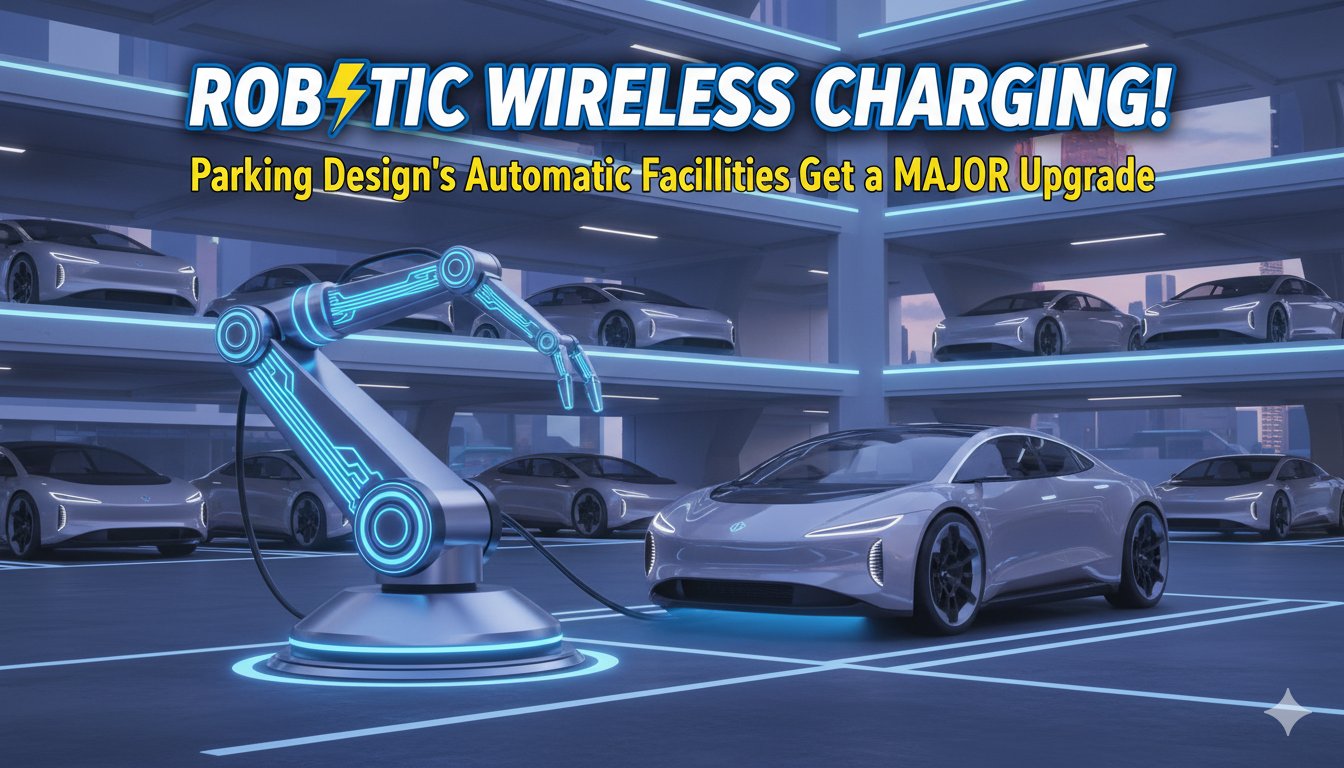
“Charging Robotics has secured an expanded order from Parking Design for advanced wireless EV charging systems in automated parking facilities, including a 20% initial payment and targeted delivery in March, highlighting growing demand for cable-free solutions amid the EV market surge.”
Charging Robotics, a key player in the EV infrastructure space, is set to expand its wireless charging footprint through a new purchase order from Parking Design, a specialist in automated parking solutions. The order builds on an initial deployment, scaling up the integration of wireless systems that eliminate the need for manual plugging in densely packed automated environments.
The project focuses on deploying stationary wireless charging pads that allow EVs to charge seamlessly while parked in robotic facilities. This technology uses inductive charging coils embedded in parking spots, paired with vehicle-side receivers, to transfer power efficiently without physical connections. AI-driven algorithms optimize energy distribution across multiple vehicles, reducing downtime and supporting higher throughput in urban parking hubs.
Financially, the deal includes an upfront 20% payment from Parking Design, underscoring confidence in the system’s performance. The expanded scope aims to cover additional bays in the facility, potentially increasing capacity for simultaneous charging sessions. This move aligns with broader trends in the U.S. EV market, where infrastructure investments are accelerating to meet federal incentives under the Inflation Reduction Act.
Key Project Milestones
Order Expansion: Shift from pilot to full-scale integration, adding more charging units to handle diverse EV models.
Technology Edge: Systems incorporate machine learning for predictive charging, minimizing grid strain during peak hours.
Operational Benefits: Enhances space efficiency in automated lots by removing cable clutter, ideal for high-density urban areas like New York or Los Angeles.
In terms of market impact, shares of Charging Robotics (OTC: CHEV) have shown positive movement, closing at $5.50 on recent trading, up from a previous close amid investor optimism in wireless tech. The EV charging sector continues to attract capital, with U.S. installations projected to grow 25% annually through 2030, driven by major automakers like Tesla and Ford pushing for wireless compatibility.
Sector Implications The partnership positions Charging Robotics as a frontrunner in niche applications where traditional wired chargers fall short. Automated parking facilities, increasingly adopted in commercial real estate, benefit from this innovation by offering value-added services to EV owners, potentially boosting property revenues. Competitors in the wireless space, such as WiTricity, face heightened rivalry as standards like SAE J2954 evolve to support higher power levels up to 11 kW.
Looking ahead, this delivery could serve as a blueprint for similar rollouts in shopping malls, airports, and residential complexes across the U.S., where space constraints demand contactless solutions. The emphasis on sustainability ties into national goals for reducing emissions, with wireless systems contributing to faster adoption rates among fleet operators.
| Aspect | Details |
|---|---|
| Charging Capacity | Up to 11 kW per vehicle, scalable for fleets |
| Efficiency Rate | 90-95% energy transfer, minimizing losses |
| Compatibility | Works with major EV standards, including CCS and CHAdeMO adaptations |
| Cost Savings | Reduces maintenance on cables and plugs by 40% over five years |
Executive insights emphasize the strategic value: the expanded order validates the technology’s viability in real-world settings, paving the way for broader commercialization in the competitive EV ecosystem.
Disclaimer: This news report is for informational purposes only and does not constitute investment advice or recommendations. All information is based on publicly available sources and should not be relied upon for making financial decisions.