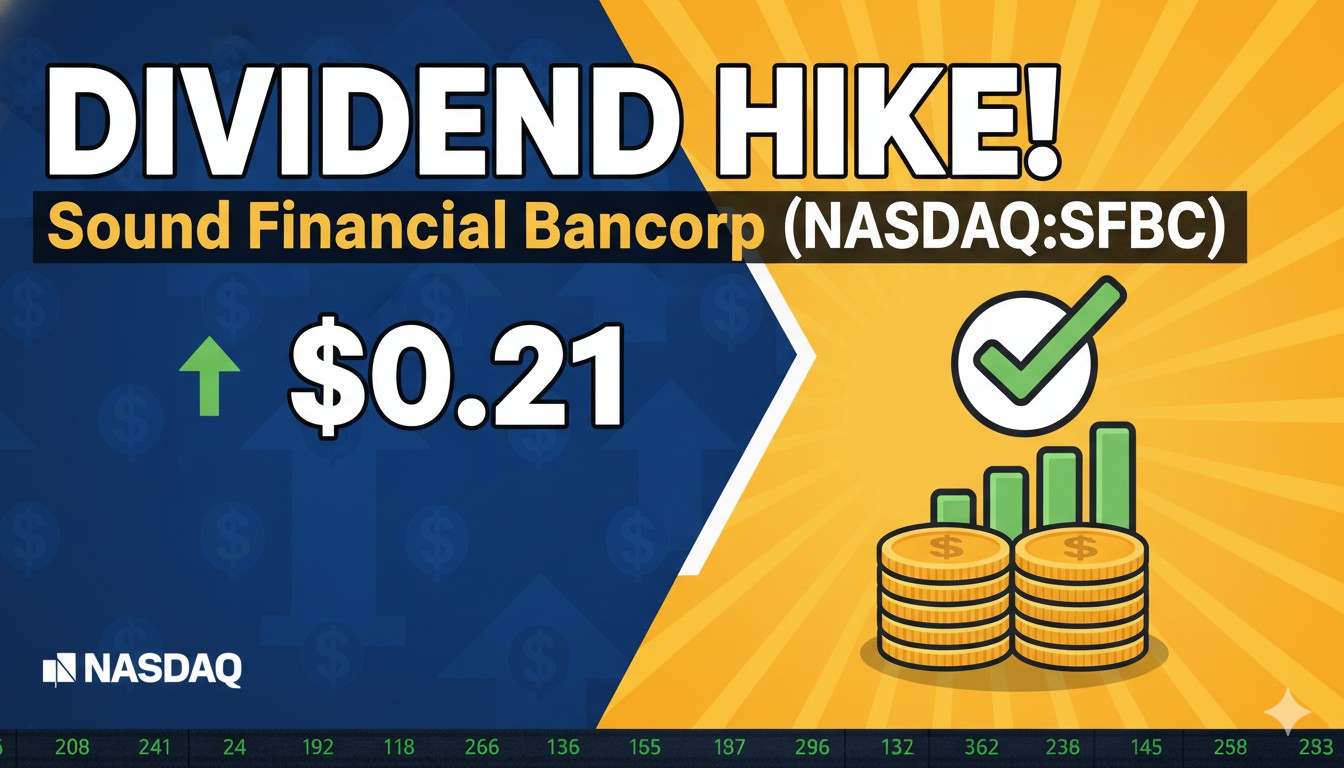
Sound Financial Bancorp has declared a quarterly cash dividend of $0.21 per share, representing a 10.5% increase from the previous $0.19 payout. The dividend is payable on February 23, 2026, to shareholders of record as of February 9, 2026. This announcement accompanies solid Q4 2025 results, featuring higher net income, expanded deposits, and improved efficiency despite ongoing margin pressures.
Dividend Increase and Q4 2025 Financial Performance
Sound Financial Bancorp, the holding company for Sound Community Bank, reported robust fourth-quarter results that underscored disciplined financial management and operational progress. The company’s Board of Directors approved the raised quarterly dividend of $0.21 per share, up from $0.19 in the comparable prior period, signaling confidence in the institution’s earnings power and capital position. This adjustment brings the annualized dividend to $0.84 per share, offering a forward yield of approximately 1.9% based on recent share prices around $44.
The dividend reflects the company’s consistent focus on shareholder returns while maintaining a conservative payout ratio. With a payout ratio hovering around 27% based on recent earnings, the increased distribution remains well-supported and leaves room for reinvestment in growth initiatives.
Strong Earnings Growth in Q4
For the fourth quarter of 2025, Sound Financial Bancorp posted net income of $2.2 million, or $0.87 per diluted share. This represents a notable improvement from $1.7 million ($0.66 per diluted share) in the third quarter of 2025 and $1.9 million ($0.74 per diluted share) in the fourth quarter of 2024. The year-over-year increase in profitability highlights effective expense management and favorable end-of-year adjustments that bolstered results.
Total revenue reached approximately $9.53 million in the quarter, up 1.6% from the prior-year period. Net interest income stood at $8.7 million, reflecting a 5.4% year-over-year increase despite a 3.1% sequential decline. The net interest margin compressed slightly to 3.36% annualized, compared to 3.48% in the prior quarter and 3.13% a year earlier, amid ongoing challenges in the interest rate environment and funding cost dynamics.
Noninterest income totaled $867 thousand, down modestly from prior periods, while noninterest expense improved significantly to $6.8 million—a 10.9% reduction from the third quarter and 3.1% lower than the fourth quarter of 2024. The provision for credit losses was $104 thousand, reflecting continued prudent risk management.
Balance Sheet Expansion and Liquidity Improvements
The company’s balance sheet demonstrated healthy growth and enhanced stability. Total assets rose to $1.09 billion at December 31, 2025, marking a 3.0% increase from the end of the third quarter and a 9.9% gain year-over-year.
Loans held for portfolio totaled $905.5 million, relatively stable with a slight 0.5% sequential dip but up 0.6% from the prior year. Deposits showed stronger momentum, climbing to $948.9 million—a 5.6% sequential increase and 13.3% year-over-year growth. Noninterest-bearing deposits remained steady at $132.6 million.
The loans-to-deposits ratio improved to 96%, down from 101.45% in the third quarter and 108% a year earlier, indicating better funding alignment and reduced reliance on wholesale sources. Liquidity enhancements and declining funding costs supported balance sheet repositioning and positioned the company to capitalize on its commercial loan pipeline.
Credit Quality Remains Stable
Asset quality trends were generally favorable despite some quarterly fluctuations. Nonperforming loans increased to $5.8 million from $2.7 million in the prior quarter, resulting in a nonperforming loans-to-total-loans ratio of 0.64%. Management attributed the rise primarily to well-secured credits with strong collateral coverage, rather than widespread deterioration.
The allowance for credit losses on loans stood at 0.95% of total loans, consistent with recent levels. Overall credit metrics remain solid, supporting the company’s ability to pursue growth while maintaining conservative underwriting standards.
Capital Strength and Outlook
Sound Community Bank remains well-capitalized under regulatory standards, providing a strong foundation for future activities. Management highlighted ongoing efforts to optimize funding costs, strengthen liquidity, and enhance margin performance. While many deposits are slated for repricing in the first half of 2026, the company is focused on funding commercial opportunities and supporting loan expansion.
Operational advancements, including automation and cost controls, contributed to efficiency gains and positioned the institution for an anticipated recovery in mortgage and broader lending markets.
Key Financial Metrics Comparison
Management Commentary
| Metric | Q4 2025 | Q3 2025 | Q4 2024 | YoY Change |
|---|---|---|---|---|
| Net Income | $2.2 million | $1.7 million | $1.9 million | +15.8% |
| Diluted EPS | $0.87 | $0.66 | $0.74 | +17.6% |
| Net Interest Income | $8.7 million | $8.9 million | $8.2 million | +5.4% |
| Net Interest Margin (annualized) | 3.36% | 3.48% | 3.13% | +23 bps |
| Noninterest Expense | $6.8 million | $7.7 million | $7.1 million | -3.1% |
| Total Assets | $1.09 billion | $1.06 billion | $993.6 million | +9.9% |
| Loans Held for Portfolio | $905.5 million | $909.7 million | $900.2 million | +0.6% |
| Total Deposits | $948.9 million | $898.9 million | $837.8 million | +13.3% |
| Loans-to-Deposits Ratio | 96% | 101.45% | 108% | Improved |
| Nonperforming Loans Ratio | 0.64% | N/A | N/A | Stable |
Leadership emphasized consistent expense discipline, automation enhancements, and funding cost management as drivers of year-over-year performance gains. The company is viewed as well-positioned for eventual market recovery, backed by a solid commercial pipeline and operational flexibility.
Disclaimer: This article is a news report based on publicly disclosed information and is provided for informational purposes only. It does not constitute investment advice, recommendations, or solicitation to buy or sell securities. Investors should perform their own due diligence and consult with qualified financial professionals before making any investment decisions.