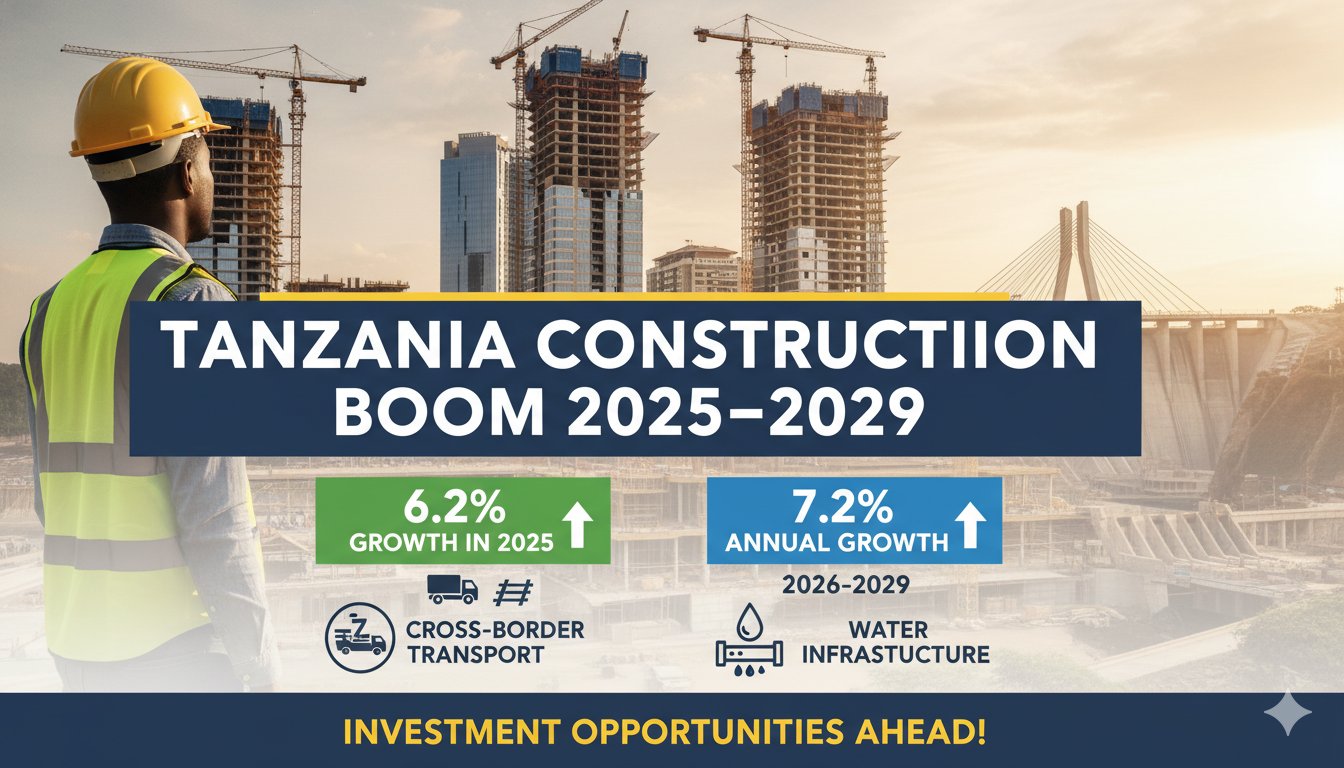
“Tanzania’s construction sector is poised for robust expansion, with a projected 6.2% growth in 2025 accelerating to a 7.2% average annual rate from 2026 to 2029, fueled by major investments in regional transport links and essential water systems that enhance trade, sustainability, and economic resilience.”
Tanzania’s Construction Boom: Infrastructure Investments Propel Economic Momentum
Tanzania’s construction landscape is undergoing a transformative phase, marked by significant public and private investments that are reshaping the nation’s infrastructure backbone. The sector, which already accounts for a substantial portion of the country’s GDP, saw output reach approximately TZS 29.26 trillion in 2025, reflecting a 7% year-over-year increase from the previous year. This growth trajectory is underpinned by strategic projects aimed at bolstering connectivity across borders and addressing critical water needs, positioning Tanzania as a key player in East Africa’s economic integration.
Key drivers include surging foreign direct investment, which climbed 21.6% to TZS 17.8 trillion in the fiscal year ending mid-2025, with manufacturing and transportation sectors drawing the lion’s share. The government’s push for enhanced US ties has opened doors for potential collaborations in mining, agro-processing, and logistics, further amplifying construction activity. Amid a national GDP expansion of 5.6% in 2024 and a forecasted 6% in 2025, the construction industry is not only a growth engine but also a creator of formal jobs, with estimates suggesting over 41,000 new positions generated through recent project registrations.
Sector Breakdown and Growth Projections
The construction industry in Tanzania spans residential, commercial, industrial, institutional, and infrastructure segments, each contributing uniquely to the overall momentum. Infrastructure, capturing 38.55% of the market share in 2025, is the dominant force, projected to expand at an 11.32% CAGR through 2031. New constructions dominate, holding 83.4% of activity, while modern methods like prefabrication are gaining ground, expected to grow at 13.35% annually.
Here’s a detailed forecast of output growth across key sectors:
| Sector | 2025 Growth (%) | 2026-2029 AAGR (%) | Key Contributing Factors |
|---|---|---|---|
| Infrastructure | 11.32 | 7.2 | Cross-border rail and road upgrades, water supply expansions |
| Residential | 8.5 | 6.8 | Urbanization in Dar es Salaam, affordable housing initiatives |
| Commercial | 7.0 | 6.7 | Tourism-driven developments, mixed-use schemes |
| Industrial | 9.4 | 8.0 | Manufacturing hubs, energy-related builds |
| Institutional | 6.5 | 7.0 | Health and education facilities upgrades |
These projections highlight a shift toward sustainable and resilient builds, with public funding accounting for 64.3% of investments in 2025, supplemented by rising private inflows at an 11.95% growth rate.
Cross-Border Transport Initiatives: Enhancing Regional Trade
A cornerstone of Tanzania’s construction surge is the emphasis on cross-border transport networks, which are vital for unlocking trade potential with neighbors like Zambia, Kenya, Uganda, Burundi, and the Democratic Republic of Congo. The refurbishment of the 1,860km Tanzania-Zambia Railway stands out as a flagship endeavor, involving extensive track rehabilitation, workshop upgrades, and operational enhancements. This project, valued at TZS 3.8 trillion, aims to revive a critical artery connecting Zambia’s mineral-rich Copperbelt to the port of Dar es Salaam, reducing freight costs by up to 40% and enabling trains to haul 10,000 tonnes per trip—equivalent to 500 truckloads.
Complementing this are advancements in the Standard Gauge Railway system, with allocations of TZS 1.51 trillion in the 2025/26 budget accelerating sections from Dar es Salaam to Morogoro, Dodoma, Tabora, Isaka, and Mwanza. Extensions toward Kigoma and cross-border links into Burundi and eastern DRC are in planning, promising direct Indian Ocean access to Central Africa. Freight services on operational segments have already scaled to two weekly shipments, alleviating road congestion and boosting delivery efficiency.
Road projects are equally ambitious. The African Development Bank’s TZS 6.7 trillion commitment supports priority routes, including the Bagamoyo-Pangani-Tanga-Horohoro stretch, allocated TZS 269.5 billion to slash travel times between Dar es Salaam and Tanga. Upgrades to the 342.9km Tabora-Koga-Mpanda Road and the 468km Kalemie-Nyunzu-Manono corridor in collaboration with the DRC enhance connectivity, facilitating mineral exports and agricultural trade. The Kigongo-Busisi Bridge across Lake Victoria and the Kwala Dry Port further streamline logistics, with the Bus Rapid Transit system in Dar es Salaam expanding by 20.3km at a cost of TZS 285.1 billion to improve urban mobility.
These initiatives not only foster economic multiplier effects—such as job creation peaking during construction phases—but also align with broader goals like the African Continental Free Trade Area, positioning Tanzania as a regional hub.
Water Infrastructure: Building Resilience Amid Climate Challenges
Water infrastructure investments are another pivotal driver, addressing both immediate supply needs and long-term climate resilience. With urban populations swelling, particularly in Mwanza and Dar es Salaam, projects focus on expanding access to potable water and sanitation, targeting universal coverage by 2030. The Lake Victoria Water and Sanitation Project, completed in mid-2025 at €150 million, upgraded systems in Mwanza and satellite towns like Misungwi, Magu, Lamadi, Bukoba, and Musoma. This included the Butimba Water Treatment Plant, benefiting over two million residents with improved hygiene and supply reliability.
German funding of TZS 78.58 billion supports water utilities in securing loans for system reconstructions, emphasizing climate adaptation and natural resource conservation. The African Development Bank’s $125.3 million allocation for Dodoma region’s water resources includes dam and treatment plant construction, serving Bahi, Chemba, and Chamwino towns while enhancing sanitation for 1.5 million people by 2051.
The Tanzania Water Investment Programme, aiming for $15.02 billion by 2030, allocates 40% to social well-being (drinking water and sanitation), 32% to economic water management, 20% to climate resilience, and 8% to institutional strengthening. Green bonds issued by the Tanga Urban Water Supply and Sanitation Authority raised over 53 billion Tanzanian shillings in 2024, funding expansions with a mix of local and international capital. Rural efforts, like the Phase II Rural Water Supply and Sanitation Program, extend coverage to underserved areas, while the Zanzibar Water Investment Programme targets sustainable supply for tourism and agriculture, planning to irrigate over 1,500 hectares through small dams.
These water-focused builds mitigate drought risks in regions like Dodoma, where LoCAL Facility grants have enabled boreholes transforming livelihoods by providing clean water and enabling income-boosting activities.
Prefabricated and Green Construction Trends
Emerging trends in prefabricated construction are accelerating project timelines and addressing skilled labor shortages. The segment grew 9.4% in 2025 to TZS 1.27 trillion, with a forecasted CAGR of 8.0% to TZS 1.89 trillion by 2029. Green building incentives promote sustainable practices, aligning with policies mandating Building Information Modeling for select public projects.
Competitive Landscape and Challenges
The market remains competitive, with international firms handling megaprojects and local contractors focusing on mid-sized works. Material volatility and labor gaps pose hurdles, but supplier partnerships and training programs are mitigating these. Overall, the sector’s resilience is evident, with output poised to reach TZS 40.44 trillion by 2029.
Disclaimer: This article is for informational purposes only and does not constitute financial advice, investment recommendations, or endorsements of any specific projects or entities. Readers should conduct their own research and consult professionals before making decisions based on this content.